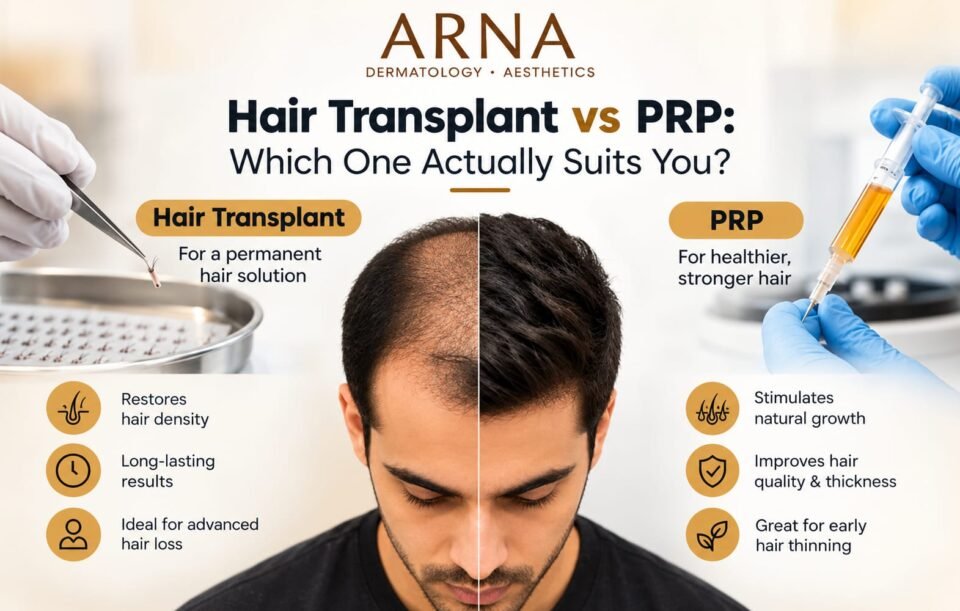
PRP is for hair that is thinning but still alive. A hair transplant is for areas where hair has stopped growing altogether. PRP slows loss and thickens existing hair. A transplant moves healthy hair into bald areas. They solve different problems, which is why the “vs” in this debate is a little misleading.
If you’re standing in front of the mirror wondering which one to book, read on. By the end you should know which camp you fall into, or at least what to ask at your consultation.
Why people get confused between the two
Hair loss clinics tend to talk about “hair restoration” as one big bucket. So someone with a slightly widening parting and someone with a clearly receded hairline both end up Googling the same thing.
Here’s the thing. Their situations are nothing alike.
The first person still has follicles. They’re just shrinking, a process called miniaturisation, mostly driven by genetics and hormones (androgenetic alopecia). The second person has areas where follicles have given up. You can’t wake up a dead follicle with injections, no matter how good the injection is.
Once you understand that one distinction, the choice gets a lot easier.
What is PRP for hair loss?
PRP stands for platelet-rich plasma. The doctor takes a small sample of your own blood, spins it in a centrifuge to concentrate the platelets, and injects that plasma into the scalp areas that are thinning.
Platelets carry growth factors. The idea is that delivering a concentrated dose near struggling follicles nudges them back into a longer growth phase.
What it does well
- Reduces shedding in early thinning
- Improves thickness and density of existing hair
- Supports hair that’s been weakened by stress, nutritional gaps, or post-illness shedding
- Needs no surgery and little to no downtime
What it can’t do
- Create a new hairline
- Regrow hair on a smooth, shiny bald patch
- Work as a one-time fix
PRP is a course, not a single appointment. Most protocols start with several sessions spaced about a month apart, followed by maintenance sessions a few times a year. Visible change usually takes around three to six months, and it varies from person to person. Anyone promising overnight results is selling you something.
What is a hair transplant?
A hair transplant is a minor surgical procedure. Follicles are taken from a “donor area”, usually the back and sides of the scalp where hair is genetically resistant to balding, and placed into thinning or bald zones.
The two techniques you’ll hear about most:
- FUE (Follicular Unit Extraction): individual follicles are extracted one by one and implanted.
- DHI (Direct Hair Implantation): a variation where follicles are loaded into a special pen-like implanter and placed directly, with more control over angle and direction.
Which one is better depends on your donor hair, the area being covered, and what you want the result to look like. A good doctor will explain the trade-offs, not push a brand name.
What it does well
- Permanent hair in bald areas
- Hairline reconstruction
- Filling in crown and frontal zones, and even beard or eyebrow gaps
What to know before you commit
- Transplanted hairs shed at around two to four weeks. That’s normal, not failure.
- New growth begins around three to four months.
- Full results can take 12 to 18 months.
- You need a decent donor area. Not everyone has one.
- Your untransplanted native hair can keep thinning, which is why medical treatment often continues afterwards.
Hair transplant vs PRP at a glance
PRP | Hair transplant | |
Best for | Early to moderate thinning | Established baldness, receding hairline |
How it works | Stimulates existing follicles | Relocates healthy follicles |
Procedure | Injections, about an hour | Surgical, usually a full day |
Downtime | Minimal | A few days to a week or two of care |
Sessions | Multiple, plus maintenance | Usually one (sometimes a second for density) |
Results timeline | 3 to 6 months | 12 to 18 months |
Permanence | Needs maintenance | Transplanted hair is long-lasting |
Cost pattern | Per session, adds up over time | Higher upfront, based on grafts needed |
Which one is right for you? Five honest questions
- Can you still see fine, short hairs in the thinning area? If yes, there are living follicles there. PRP and other medical therapy have something to work with.
- Is there a completely smooth bald patch? If so, PRP alone is unlikely to bring it back. This is transplant territory.
- How long has the hair loss been going on? Recent, noticeable shedding often responds better to early treatment. Loss that’s been stable for years usually means the follicles are gone.
- Do you have enough donor hair? A transplant is only as good as what’s available to move. A scalp examination (and sometimes a trichoscopy) answers this in minutes.
- What are you really after? Thicker, healthier hair? Or a different hairline and real coverage? Be clear about your goal, because it shapes the whole plan.
Can you combine PRP and a hair transplant?
Yes, and plenty of dermatologists do. PRP is often used before or after a transplant to support the scalp and healing. A 2025 systematic review of three clinical studies, two of them randomised controlled trials covering 217 participants, found that adding PRP to transplantation tended to give better outcomes than transplantation alone. That’s a small body of evidence, so it’s encouraging rather than conclusive.
It also makes practical sense. A transplant fixes the bald zones, while PRP and medication help protect the hair you already have around them.
What about cost?
We’d rather be upfront than throw out a number that doesn’t apply to you.
- PRP is charged per session, so the total depends on how many sessions your scalp needs.
- A transplant is usually priced by the number of grafts, which depends on how much area needs covering.
The cheapest option on paper isn’t always the cheapest in the end. A rushed, low-cost transplant that needs correcting, or a PRP course that was never going to work for your type of hair loss, costs more than getting the right plan the first time. That’s the real reason a proper consultation matters.
Is a hair transplant or PRP right for women?
Often, yes, but the pattern is different. Women tend to lose hair diffusely, with overall thinning and a widening part rather than a receding hairline. That makes the cause important: thyroid issues, iron or vitamin D deficiency, PCOS, postpartum changes and stress are all common culprits and need to be checked before any procedure. PRP is frequently a first step, and transplants are considered only when the donor area is stable and the thinning pattern suits it.
Other treatments worth knowing about
PRP and transplants aren’t the only tools. Depending on the cause and stage, a dermatologist may also recommend:
- GFC (growth factor concentrate): a similar concept to PRP, with a different preparation method
- QR678: a hair-boosting injectable formulation used in some clinics
- LLLT (low-level laser therapy): light-based stimulation of follicles
- Exosome therapy: an emerging option still being studied
- Medication and nutrition correction: often the unglamorous foundation that makes everything else work
Arna Clinic offers PRP, GFC, QR678, LLLT, exosomes and hair transplant under one roof, so the recommendation can be based on what your scalp needs rather than what a single machine can do.
What happens at a consultation at Arna Clinic?
A good hair consult shouldn’t feel like a sales pitch. Here’s what you can expect:
- A conversation first. Family history, diet, stress, medications, recent illness, how long you’ve noticed the change.
- A scalp examination. Looking at hair density, miniaturisation, and the donor area.
- Investigations if needed. Blood work for thyroid, iron, vitamin levels and hormones when the picture suggests it.
- A plan that fits. Which treatment, in what order, what results are realistic, and what you’ll need to do afterwards.
Dr. Mounika Ketha leads the clinic, which has locations around Hyderabad including Jubilee Hills. If you’d like a straightforward opinion on your hair, you can book a consultation through the clinic.
Category
Latest From Blog
Hair Transplant vs PRP: Which One Actually Suits You?
Double Chin Reduction: Choosing Between Non-Surgical, Minimally Invasive, and Surgical Treatments
Mounjaro for Weight Loss & Diabetes: Available Now at Arna Dermatology
Popular Tag
Arna Dermatology & Aesthetics in Jubilee Hills, Hyderabad offers advanced, personalized skin and hair treatments using FDA-approved technology for acne scars, pigmentation, laser hair reduction, anti-aging and hair concerns.
Contact with Us
Ground Floor, Bharati Square, Road No. 52, Rai Durg, Hyderabad, Telangana 500081, India.
Call us: +91 9100193612
Mail: arnaclinic@gmail.com
Mon-Sat: 10:00 To 07:00