

Subcision for Acne Scars in Hyderabad
Release the tether. Treat the scar at its foundation.
Acne scars are not all the same. While some scars are primarily caused by changes in the surface texture of the skin, others are tethered acne scars—where fibrous bands beneath the skin pull the surface downward and create a depressed, uneven appearance.
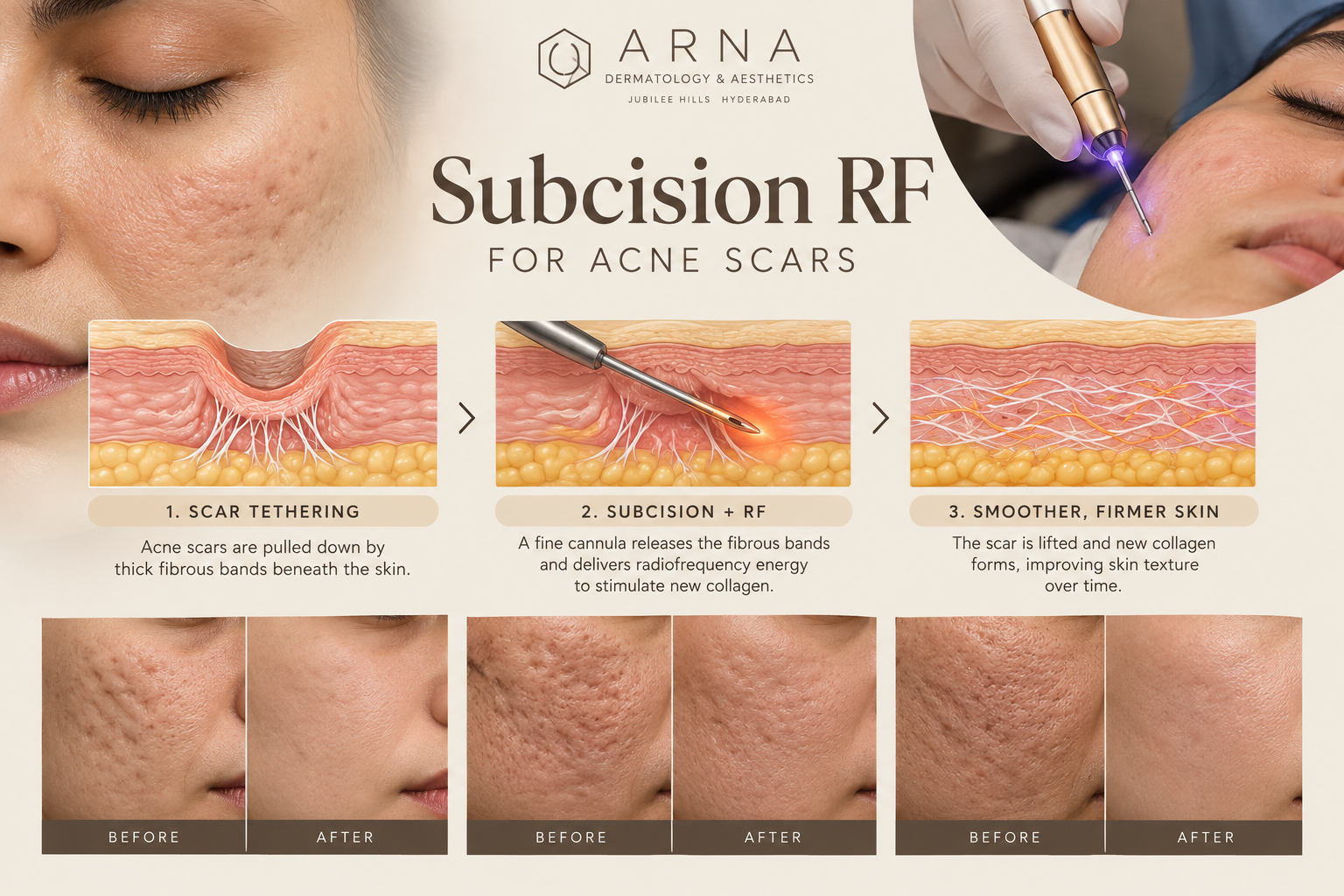
This is particularly common with rolling acne scars, which appear as broad, shallow depressions or undulations in the skin.
In these scars, simply resurfacing the skin with treatments such as fractional CO2 laser, microneedling or radiofrequency microneedling (MNRF) may not completely address the underlying problem. The skin may need to be released from the fibrous attachments underneath before resurfacing and collagen-remodelling treatments can achieve their full potential.
This is where subcision for acne scars becomes an important part of an acne scar treatment plan.
At ARNA Dermatology & Aesthetics, Jubilee Hills, Hyderabad, subcision is selected according to the type, depth and tethering pattern of your acne scars and may be combined with other acne scar treatments for a comprehensive approach.
What is Subcision for Acne Scars?
Subcision, also known as subcutaneous incisionless surgery, is a minimally invasive procedure used to treat depressed and tethered acne scars.
During subcision, a needle, cannula or other specialised device is introduced beneath the scar. The instrument is moved within the appropriate tissue plane to release the fibrous bands that are tethering the scar to the deeper tissues.
Once these attachments are released, the depressed scar can become less tethered and may gradually elevate as new connective tissue and collagen form during healing.
Subcision is particularly useful for rolling acne scars and depressed scars with underlying tethering. It is not, however, a universal treatment for every type of acne scar. Ice-pick scars, deep boxcar scars and scars without significant tethering may require different procedures or combination treatments.
Why Do Some Acne Scars Need Subcision First?
Think of a tethered acne scar like a piece of fabric being pulled down from underneath.
You can smooth the surface of the fabric, but if something underneath continues to pull it down, the depression can remain.
A similar principle applies to tethered acne scars.
Fractional CO2 laser and RF microneedling primarily work by creating controlled injury and stimulating collagen remodelling in the skin. However, they do not directly perform the same mechanical release of deep fibrous tethering that subcision does.
Therefore, when significant tethering is present, releasing the scar first may make subsequent collagen-remodelling treatments more useful.
Clinical literature supports the use of subcision as an important component of treatment for rolling/tethered acne scars, and combination approaches with fractional lasers, microneedling and RF-based treatments have been studied. (JDerm)
At ARNA, the treatment plan is therefore based on the scar morphology rather than using the same procedure for every acne scar.
Types of Subcision for Acne Scars
There are different ways of releasing tethered acne scars. The technique is selected according to the scar, its depth, the extent of tethering and the treatment plan.
1. Physical Subcision – Needle or Cannula Subcision
Traditional subcision uses a needle or blunt cannula introduced beneath the scar to mechanically release the fibrous bands.
This may also be referred to as:
- Needle subcision
- Cannula subcision
- Physical subcision
- Traditional subcision
A needle can be used to mechanically break the fibrous strands beneath the scar. A blunt cannula can also be used to move beneath the scar and release tethering across a broader area.
Cannula-based techniques have been investigated as modifications of conventional needle subcision, with some studies reporting fewer adverse effects with cannula techniques. (DOI)
Physical subcision remains an important option for appropriately selected rolling and tethered acne scars.
2. RF Subcision – Radiofrequency-Assisted Subcision
RF subcision combines the principle of subcision with radiofrequency energy.
Instead of relying solely on mechanical release, radiofrequency energy can be incorporated into the procedure to deliver controlled thermal energy within the treatment area.
RF-assisted subcision is another option that may be considered depending on the scar morphology and treatment objective.
The choice between conventional subcision, RF-assisted subcision and other techniques should be made after assessing the individual scar pattern rather than simply choosing a procedure based on the name of the technology.
3. Laser Subcision – MicroLift
A newer approach to subcision uses a 1470 nm diode laser fibre to perform subdermal laser-assisted scar release.
At ARNA Dermatology & Aesthetics, we use our MicroLift laser-based approach for appropriately selected tethered acne scars.
Instead of relying only on a needle or cannula to mechanically release the tethering, the laser fibre is introduced into the subdermal plane and controlled laser energy is used to address the tissue beneath the scar.
Published research has described 1470 nm diode laser-assisted subdermal scar subcision, including its use in combination with fractional CO2 laser for rolling acne scars. (PubMed Central (PMC))
Why consider MicroLift for acne scars?
Laser-assisted subcision may offer advantages in selected patients because it combines subdermal treatment with controlled laser energy.
Depending on the individual patient and treatment area, it may be associated with:
- Less mechanical trauma than extensive traditional subcision
- Potentially less bruising
- Less discomfort for some patients
- More controlled treatment of the subdermal tissue
- The ability to combine subcision with other collagen-remodelling treatments when appropriate
However, MicroLift is not automatically better for every acne scar. The most appropriate technique depends on the type and depth of the scar, degree of tethering, skin type and previous treatments.
Subcision + Fractional CO2 Laser
For many patients with acne scarring, treating the tethering alone is not enough.
Once the underlying scar has been released, fractional CO2 laser can be used to address surface irregularities, texture and collagen remodelling.
This creates a complementary approach:
Subcision → releases the tether
Fractional CO2 → remodels the skin surface and stimulates collagen
Studies and reviews have reported benefits from combining subcision with fractional laser treatments in appropriately selected acne scars. (JDerm)
The treatments may be performed in the same treatment plan or at separate sessions depending on the patient’s skin, scar characteristics and treatment settings.
Subcision + RF Microneedling
Microneedling radiofrequency (MNRF/RF microneedling) is another commonly used acne scar treatment.
RF microneedling delivers controlled energy into the dermis to stimulate collagen remodelling and improve skin texture.
When a scar has significant tethering, subcision may be incorporated into the treatment plan before or alongside RF microneedling.
Research has reported combination approaches involving subcision and fractional radiofrequency/microneedling for depressed acne scars. (DOI)
The objective is to address both components of the scar:
Release the tether + remodel the dermis.
Which Acne Scars Benefit From Subcision?
Subcision is most useful when acne scars are depressed and tethered.
It is particularly useful for:
- Rolling acne scars
- Tethered acne scars
- Depressed acne scars
- Broad, shallow acne scars
- Acne scars that remain depressed when the surrounding skin is stretched
Not every acne scar requires subcision.
Icepick scars, deep boxcar scars and certain sharply defined scars may require treatments such as TCA CROSS, punch techniques, fractional laser, RF microneedling or other procedures instead.
Most patients have a combination of scar types, which is why an acne scar consultation and detailed assessment are important before deciding on treatment.
Is Subcision Enough to Treat Acne Scars?
Usually, acne scar treatment is not a one-procedure solution.
Acne scars can contain several different components:
Tethering + loss of volume + altered skin texture + collagen remodelling changes.
Subcision primarily addresses the tethering component.
Other treatments may subsequently be required to address texture, depth, pigmentation or volume.
Depending on your scar pattern, your treatment plan may include:
- Subcision
- MicroLift laser-assisted subcision
- RF subcision
- Fractional CO2 laser
- RF microneedling/MNRF
- Microneedling
- TCA CROSS
- Dermal fillers
- Skin boosters or regenerative treatments
- Other combination acne scar procedures
The aim is not simply to perform more procedures. The aim is to select the right treatment for the specific scar component.
Subcision for Acne Scars in Jubilee Hills, Hyderabad
If you are looking for acne scar treatment in Hyderabad, subcision for rolling acne scars, or acne scar treatment in Jubilee Hills, a detailed assessment is important before choosing a procedure.
At ARNA Dermatology & Aesthetics, Jubilee Hills, our approach to acne scars focuses on identifying the underlying scar pattern and selecting treatments accordingly.
If your scars are tethered, simply resurfacing the skin may not address the underlying problem.
Release the tether. Remodel the skin. Treat the scar from the foundation upwards.
Book an Acne Scar Consultation
Consult a dermatologist to determine whether your acne scars are suitable for needle/cannula subcision, RF subcision, MicroLift laser-assisted subcision, fractional CO2 laser, RF microneedling or a combination treatment plan.
ARNA Dermatology & Aesthetics
Jubilee Hills, Hyderabad
Acne Scar Treatment | Subcision | MicroLift | Fractional CO2 Laser | RF Microneedling